




Read time: 8 mins
Key Takeaways
-
Boring surveys produce shallow responses that undermine survey data quality, client trust, and downstream analysis.
-
Conversational, mobile-optimized, and personalized surveys significantly increase response depth and reliability.
-
Engagement is no longer a “nice to have”—it is a strategic requirement for protecting data quality and research credibility.
Boring surveys are expensive surveys. Presenting findings based on shallow responses makes clients question the validity of the research. You can’t build a strategy on “It’s good,” or make meaningful distinctions when respondents treat every rating scale the same.
Your reputation, built over years of delivering high-quality insights, can be damaged by a single project with compromised data. You’re paying premium rates for respondents who provide minimal effort. Research directors may blame sample quality, screening, or fraud, but the root cause is often the same: respondents are bored, disengaged, and doing the bare minimum required to finish.
Here’s what that looks like in practice. Respondents complete surveys in a fraction of the expected time and repeatedly select the same answer. One- or two-word responses to “Why?” questions signal that respondents are mentally checked out, while generic answers like “It’s good” deliver zero actionable insight.
Engaging, well-designed survey questions change this dynamic. When respondents are genuinely interested, they provide richer, more thoughtful data—far more valuable than what sterile questioning can produce.
Why Traditional Surveys are Failing
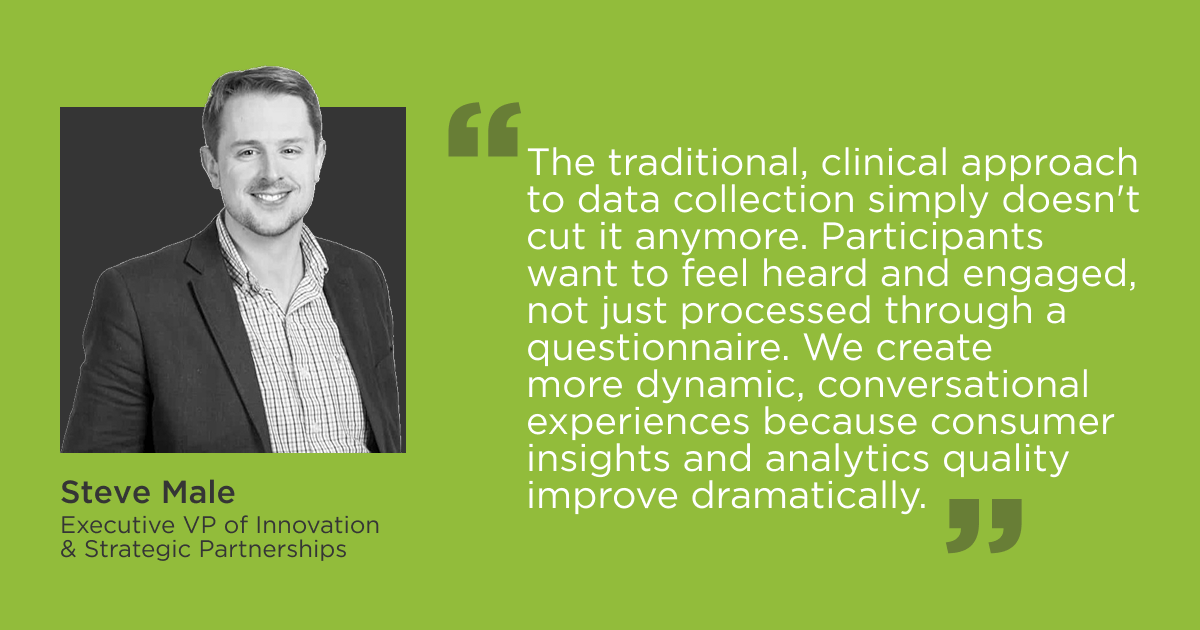
Participants expect interactive survey experiences, not clinical interrogations. Steve Male, Executive VP of Innovation & Strategic Partnerships at The Logit Group, puts it bluntly, "The traditional, clinical approach to data collection simply doesn't cut it anymore. Participants want to feel heard and engaged, not just processed through a questionnaire. We create more dynamic, conversational experiences because consumer insights and analytics quality improve dramatically.”
In data tables, you've seen rows of identical ratings, open-ends with "It's fine," and completion times that seem impossibly fast. Survey fatigue has reached critical mass, and survey data quality is paying the price. When you deliver insights to Fortune 500 clients, disengaged respondents compromise your entire research operation.
So what did we do at The Logit Group? We did a research-on-research study with inca, from nexxt intelligence. We proved that 78% of participants rated conversational surveys as better than traditional formats, and 65% received top ratings for quality compared to just 13% in traditional formats. The "TikTok-ification" of content consumption has fundamentally changed how people interact with information. Your fieldwork vendors, using traditional data collection methods, create an engagement problem you inherit, which shows up in your survey data quality.
We’re happy to share more of what we learned and want you to be able to take everything up a notch. Ready for the deets?
5 Ways to Make Surveys Fun Again
The shift has moved from "completing surveys" to "creating experiences worth completing." Here are five proven approaches that transform data quality—not through better screening or fraud detection, but through better engagement.
1. Use Conversational AI for Dynamic Follow-Ups
The Problem
Traditional survey: "What do you like about this product?"
Typical response: "It's good."
Your coding team: collectively sighs
The Solution
When someone gives you "I like the value," QuestionIQ automatically follows up with, "What specific aspects of the value stand out to you?" The system identifies up to five distinct mentions in a single response and systematically probes each. This creates conversation-like interactions that respondents actually engage with because the follow-ups are directly related to their specific answers.
The Impact
Our joint inca study showed open-ended responses were nearly 50% longer in conversational format. More importantly, 65% of responses received top quality ratings compared to just 13% in traditional format. That's not a marginal improvement—that's the difference between actionable insights and wasted budget.
Here's what actually happens: The platform knows when to probe deeper and when to move on. Built by researchers who understand online data collection challenges, it delivers qualitative-style depth at quantitative scale. By the time your last respondent clicks "submit," the coding is complete, the data is clean, and you're ready for immediate analysis. No more waiting weeks for manual coding completion.
2. Optimize for Mobile with Touch-Friendly Design
The Reality Check
Your respondents aren't sitting at desks with large monitors anymore. They're on their phones, waiting for coffee, riding the subway, or half-watching Netflix. If your survey requires precise mouse clicks or works poorly on mobile, you've already lost them.
What Works
Large, thumb-friendly buttons and tap areas
Simplified question formats (multiple choice, sliders, single-choice over complex matrices)
Responsive design that adapts to any screen size
Questions that fit on one screen without excessive scrolling
The Data
Qualtrics research proves mobile-friendly surveys generate significantly higher response rates. More critically, mobile optimization isn't just about completion—it's about quality. When respondents struggle with interface issues, they rush through questions just to finish. When the experience is smooth, they engage properly.
The Warning
Mobile optimization is table stakes now, not a competitive advantage. If you're not designing mobile-first in 2025, you're actively damaging your data quality.
3. Gamify with Progress Indicators and Milestone Rewards
Why This Works
The International Journal of Market Research found that gamified surveys increased both completion rates and data quality. Progress bars and milestone rewards tap into basic psychology—people want to finish what they start, especially when they can see how close they are.
Practical Implementation
Visual Progress: "You're 40% complete—great work!" works better than question counters
Milestone Rewards: "Section 1 complete! Your insights are helping us improve..." provides validation
Time Estimates: "About 3 minutes remaining" manages expectations and reduces abandonment
The Behavioral Science
Progress indicators work because they transform an abstract task into a visible achievement. When someone sees they're 75% done, abandoning feels like wasting the effort already invested. This isn't manipulation—it's respect for the respondent's time and a clear contract about what you're asking from them.
What NOT to Do
Don't use fake progress bars that jump around or reset. Respondents notice, and it destroys trust immediately.
4. Add Real-Time Feedback and Validation
The Problem With Traditional Surveys
Respondents submit answers into a void. They have no idea if they're being helpful, if their responses make sense, or if the survey is even working properly. This uncertainty creates disengagement.
The Fix
Real-time feedback works. The American Association for Public Opinion Research found that acknowledging progress and validating responses keeps participants engaged and improves accuracy.
What This Looks Like
Immediate acknowledgment: "Thanks for sharing that detail about pricing—this helps us understand your priorities."
Clarifying prompts: If someone gives an unclear answer, ask for clarification immediately: "Could you tell us more about what you mean by 'better quality'?"
Error prevention: "You rated the product 5/5 but said you wouldn't buy it—can you help us understand why?"
QuestionIQ's relevance analysis measures response quality in real time and creates dynamic experiences that adapt to respondent feedback. The system automatically clarifies questionable responses or terminates fraudulent ones during fieldwork—when you can still course-correct—not three weeks later when you're presenting findings.
5. Personalize with Conditional Logic
Generic Surveys Are Dead
Nothing screams "we don't care about your time" louder than forcing someone to answer irrelevant questions. If someone says they don't own a car, why are you asking about their vehicle's maintenance schedule?
Conditional Logic in Action
Skip irrelevant sections automatically based on previous answers. If someone rates a product 1 or 2, dive into "what went wrong" questions. If they rate it 4 or 5, explore "what did we get right?" This creates a personalized experience where every question feels relevant.
The Proof
Research shows personalized surveys using conditional logic achieve higher completion rates and better data quality. When respondents feel the survey is specifically designed for them rather than a generic questionnaire, they engage more thoughtfully.
Advanced Personalization
The best surveys use previous answers to customize question wording: "You mentioned 'value' was important. Which specific aspects of value matter most to you?" This creates continuity and shows you're actually listening to their responses.
The Bottom Line: Engagement Equals Quality
When we tested inca against traditional surveys, participants spent more time with the conversational format (11.8 minutes versus 9.3 minutes). Still, they perceived the time as shorter—a clear indicator of improved engagement. More importantly, 78% rated the conversational experience better than traditional surveys.
For your business, this means engaged respondents don't just complete surveys; they provide responses you can actually use. They write thoughtful open-ends, differentiate meaningfully on rating scales, and give you the nuanced insights that inform strategy rather than just confirming what you already know.
The vendors who understand this deliver data you can build recommendations on. The ones who don't? They're delivering completion rates while you explain to clients why the insights are shallow.
Ready to stop wasting money on "It's good" responses? Request a demonstration of QuestionIQ to see how conversational AI transforms survey engagement and data quality on your next research project.
Fun Surveys = Better Data (And Better ROI)
Stop wasting budget on shallow responses that can't inform strategic decisions. Conversational AI eliminates post-fieldwork coding delays, and data is analysis-ready when the last respondent clicks "submit." Better survey data quality means more confident recommendations and a protected reputation.
Making surveys engaging isn't "soft." It's strategic data quality management. The experience economy demands that you respect participants' time and intelligence. Combine effective survey questions with interactive survey design and modern data collection tools to protect both your reputation and your margins.
Delivering Fortune 500-quality insights means survey data quality isn't negotiable. Disengaged participants produce shallow, unreliable responses that put your reputation at risk. Recognizing engagement as a strategic data quality issue, not just an operational detail, sets research directors apart and enables them to deliver better insights and maintain their competitive edge.
FAQs
Why does survey engagement have such a strong impact on survey data quality?
Engaged respondents spend more time, differentiate meaningfully between answers, and provide richer open-ended feedback, resulting in more reliable and actionable data.
How do conversational surveys improve data quality compared to traditional formats?
Conversational surveys dynamically probe responses, clarify vague answers in real time, and adapt to participant input, producing deeper insights at scale.
Is improving survey data quality about better fraud detection or better design?
While fraud detection matters, better survey design and engagement prevent low-quality responses before they enter the dataset.