




Read time: 2 mins
Canadians buying Canadian products remains a strong trend amid ongoing trade tensions with the United States. New survey findings from Narrative Research and The Logit Group show that 65% of Canadians have sought out Canadian products when shopping, while 51% have checked product labels to avoid goods made in the U.S. The results also reveal how Canadians are adjusting their entertainment, streaming, and travel habits.
Key Takeaways
- Buying Canadian remains the leading response to U.S. trade tensions: 65% of Canadians have sought out Canadian products, while 51% have checked labels to avoid American-made goods.
- Most Canadians continue to take action: 74% report changing at least one purchasing or travel habit, while 26% say they have not taken any of the measured actions.
- Avoiding American products extends beyond shopping: 16% have sought out Canadian entertainment, 11% have cancelled a planned trip to the U.S., and 6% have cancelled an American streaming service.
The proportion of Canadians avoiding Americans products has remained steady since February 2025, although the proportion who have cancelled a planned trip to the U.S. has decreased slightly since July 2025.
For over a year and a half we have tracked how Canadians are adjusting their purchasing habits throughout the ongoing trade war with the United States.
Throughout this time, a majority have been changing at least one of their purchasing habits in light of the ongoing issues related to U.S. trade.
Across types of activities, Canadians continue to be most likely to have sought out Canadian products when shopping (65%; up 3 points since July 2025) and looked at product labels to avoid products made in the U.S. (51%; down 2 points since July 2025). Additionally, just under two in ten residents say they sought out Canadian entertainment (16%; down 4 points since July 2025), while one in ten cancelled a planned trip to the U.S. (11%; down 8 points since July 2025). Very few Canadians report cancelling an American streaming service (6%; down 2 points since July 2025).
In the Last Few Weeks Canadians Have…
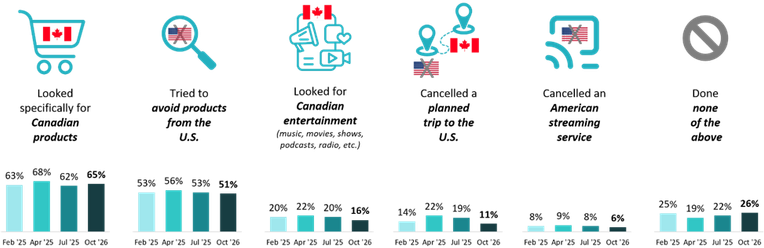
Importantly, only one-quarter of Canadians (26%; up 4 points since July 2025) have not done any of these activities, showing that a sizeable majority of residents are actively supporting the ‘buy Canadian’ sentiment.
“Across our research, we continue to see a very strong ‘buy Canadian’ sentiment,” said Margaret Chapman, COO & Partner at Narrative Research. “Residents from coast to coast to coast are continuing to support Canadian products, and this trend shows no sign of waning.”
Across generations, younger and middle-aged Canadians are less likely to seek out Canadian products and look at the labels of products to avoid purchasing American goods, while their older counterparts are most likely to do both. Millennials are most likely to seek out Canadian entertainment, while Gen X Canadians are least likely to do so. Additionally, men are more likely than women to say they cancelled an American streaming service or a planned trip to the U.S., while women are more likely to have sought out Canadian products.
Results are from an online survey conducted in partnership between Narrative Research and the Logit Group. The survey was conducted between September 21 and 28, 2026 with 1,230 Canadians, 18 years of age or older from the Logit Group’s online Canadian Omnibus. Data were weighted based on the 2021 Census, by gender, age, and region to reflect actual population distribution.
Download a PDF version with data tables
FAQs
According to the latest survey, 65% of Canadians have sought out Canadian products when shopping, an increase of three percentage points since July 2025.
Yes. More than half of Canadians (51%) have checked product labels to avoid goods made in the U.S. The proportion avoiding American products has remained relatively steady since February 2025.
The survey found that 11% of Canadians have cancelled a planned trip to the U.S., 16% have sought out Canadian entertainment, and 6% have cancelled an American streaming service. These figures have generally declined since July 2025.