




Read time: 2 mins
Canadian savings habits 2026 highlight a growing divide in financial security, as most Canadians continue to save despite rising costs, but far fewer are contributing to RRSPs, with significant differences emerging across income levels and age groups.
Key Takeaways
- Most Canadians are still saving regularly, but RRSP contributions remain significantly lower
- Higher-income households are far more likely to save and contribute to retirement accounts
- Many Canadians lack sufficient savings to cover more than a few months of expenses
As daily expenses continue to rise, two-thirds of Canadians report that they are still regularly contributing to a savings account. However, far fewer (just one-third) made a contribution to an RRSP account for the 2025 tax year.
Savings behaviours vary notably by income levels. Among Canadians with household incomes of less than $60,000, only half report saving regularly, and just 16% made an RRSP contribution. In contrast, three-quarters of those earning more than $100,000 save regularly, and more than half contributed to an RRSP in 2025. Importantly, younger Canadians (under the age of 55) are much more likely to have made RRSP contributions last year, compared to those 55 or older.
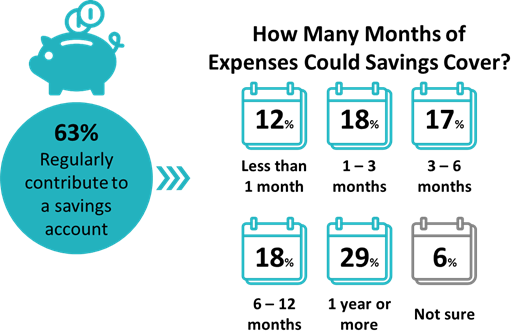
While many Canadians are saving, those savings may not provide long-term financial security for everyone. Three in ten Canadians say their savings would cover three months or less of expenses if they were laid off or faced a financial setback. By comparison, three in ten report having enough savings to last a year or longer.
“Clearly, Canadians recognize the importance of saving for a rainy day, though fewer are now making contributions for retirement,” said Margaret Chapman, COO & Partner at Narrative Research. “These findings also underscore how, unfortunately, those on lower incomes are likely increasingly falling behind, as they are less able to save for the future, illustrating a divide in the population by income.”
Results are from an online survey conducted in partnership between Narrative Research and the Logit Group. The survey was conducted between March 12 – 16, 2026 with 1,230 Canadians, 18 years of age or older from the Logit Group’s online Canadian Omnibus. Data were weighted based on the 2021 Census, by gender, age, and region to reflect actual population distribution.
Download a PDF version with data tables
FAQs
Rising daily expenses and cost-of-living pressures are likely limiting the ability to allocate funds toward long-term retirement savings.
Higher-income Canadians are significantly more likely to save regularly and contribute to RRSPs, while lower-income households face greater financial constraints.
Savings levels vary widely, with many Canadians only able to cover a few months of expenses, while others report having a year or more of financial cushion.
For more information, please contact:
Margaret Chapman, COO & Partner, Narrative Research – 902.493.3834, mchapman@narrativeresearch.ca or Sam Pisani, Managing Partner, Logit Group – 416.629.4116, sam.pisani@logitgroup.com.
Narrative Research is a non-partisan, 100% Canadian-owned research company, certified as a Women Business Enterprise (WBE). Narrative Research provides clients with state-of-the-art research and strategic consulting services.
The Logit Group is a leading North American data collection and market research execution company headquartered in Toronto, conducting large-scale projects for a variety of well-known research agencies and brands. Logit employs industry-best technologies.