




Read time: 5 mins
Enterprise research teams are under pressure to deliver fast, reliable data, which means vendors often do not get audited until something goes wrong, and by then the damage is already done. The industry reached a breaking point when a $10 million fraud case rocked the market research world, and it was not some offshore operation. It was a North American company with an established reputation.
Key Takeaways
- Modern data quality tools combine metadata, behavioral analysis, and AI detection to identify fraudulent respondents more effectively than any single verification method.
- Enterprise research teams should ask vendors exactly how they detect fraud, validate respondents, and protect data quality before fieldwork begins.
- Real-time respondent screening improves data integrity while reducing delays, costly replacements, and downstream quality issues.
That case forced a long overdue conversation about what fraud detection in online research actually requires, and what enterprise teams should be demanding from their partners before the next project kicks off. Traditional verification methods like double opt-in and email confirmation have deteriorated to the point where fraudsters can easily create multiple personas. This means that the lines of defense that once worked need to be fundamentally reconsidered.
So before your next project kicks off, ask your research execution partner exactly how they are detecting fraud in their data collection, including security measures and specific tools. If they cannot tell you how, then you have your answer. They aren't.
Why Layered Data Quality Tools Are the New Standard
Effective fraud detection today operates on two parallel tracks, content analysis and metadata analysis. Content-based detection reviews open-ended responses for AI-generated patterns or suspiciously polished language, but metadata is increasingly where the real signal lives. Metadata-based detection looks at how respondents interact with the survey environment itself, including IP address and browser fingerprinting, device consistency across sessions, and behavioral signals like mouse movement, keyboard activity, time spent per question, and whether answers are typed or pasted in. When a respondent has multiple browser tabs open, likely cross-referencing questions or using an AI agent to compose answers, that behavioral signature is detectable.
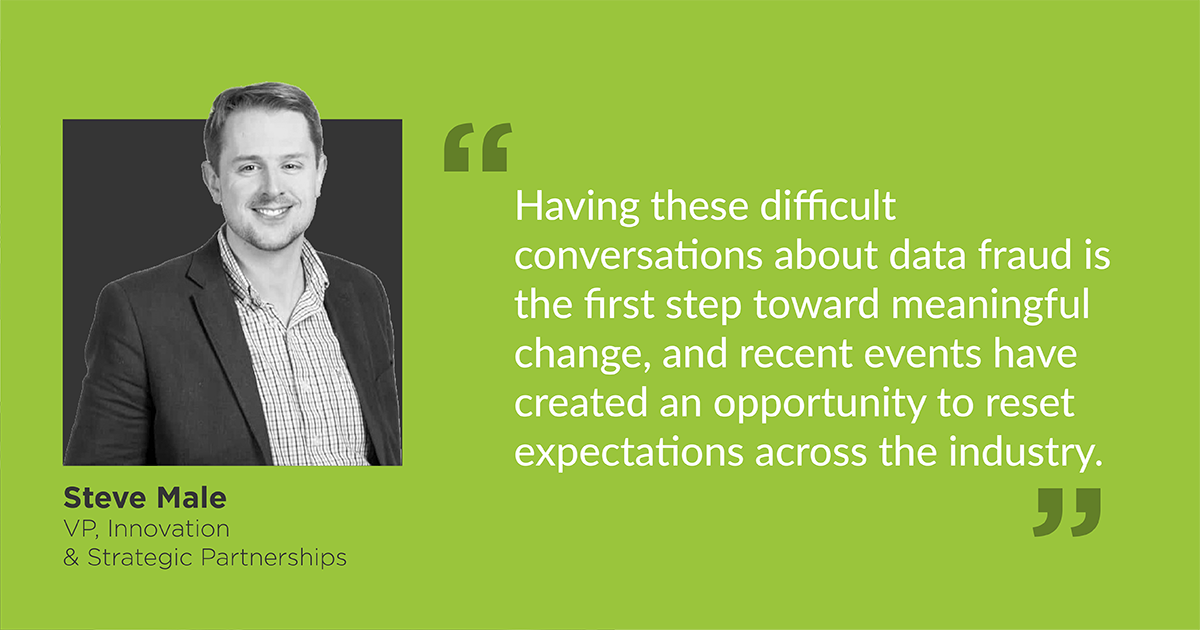
But no single data quality tool catches everything, and the most rigorous approach layers multiple detection methods simultaneously. Research from Case for Quality tested four major fraud detection systems and found that even the best tools, when used in isolation, still missed significant issues, with one study removing 24% of respondents during data cleaning after those tools had already run. The industry is at a turning point on this, and Steve Male, EVP of Innovation at The Logit Group, has been direct about what that means.
Research has shown that respondents flagged for removal typically trip four to six different quality indicators at once, and that pattern-level detection only becomes possible when you run multiple checks in parallel. Many tools evaluate respondent quality after a survey is complete, meaning a respondent finishes a 25-minute interview before anyone flags a problem. The data then gets reviewed, and if it does not pass quality thresholds, it gets sent back to the sample source for replacement, creating friction with panel partners and inflating the effective length of the interview. Real-time screening addresses this by evaluating respondents before they enter the survey, so quality issues are resolved without impacting timelines or respondent experience.
How to Spot Fraudulent Research Data
One major red flag is when samples come in heavily outside expected fielding hours, such as overnight responses for a North American study. Open-ended responses that are unusually long, unusually formal, or follow a consistent structural pattern across respondents suggest coached or AI-assisted answers. Placing an open-ended question at the end of a survey asking about the respondent's experience can yield surprisingly direct evidence, because people often drop their guard when they think the survey is essentially over.
Bots get a lot of attention in data quality conversations, but they represent less than 10% of the actual problem. The more significant and harder-to-detect threat comes from organized survey farms, which are coordinated groups of individuals who obtain questionnaires in advance, identify qualifying criteria, and use AI tools to generate polished, contextually consistent responses that pass traditional validation checks. These bad actors use AI to research brands, identify correlations between questions, and perfect open-ended responses so their answers hold together under scrutiny. These respondents do not look fraudulent on the surface, and their answers are coherent, articulate, and hit the right marks on screener logic. Older dead giveaways, like fast completion times or throwaway answers like "not sure," are no longer reliable red flags.
Knowing what to look for is only half the equation. The other half is having an honest conversation with your partner about what they are actually doing to prevent these issues at the source. Technology now makes it possible to validate respondents against LinkedIn profiles, verified mobile numbers, and identification data available through APIs, and partners who are not doing this are operating with a verification standard that fraudsters figured out how to beat years ago. Ask how your data is handled from a research security standpoint and whether the tools they are describing are genuinely AI-powered or efficiency-optimized processes that have been relabeled, because there is a meaningful gap between the two. The cost side of this equation matters too, because when it comes to price, speed, and quality, you can have two of the three but not all three at the same time.
How The Logit Group Delivers Enterprise-Grade Fraud Detection
We built Calibr8 specifically to address the multi-layered nature of the data quality problem. Rather than relying on any single detection method, Calibr8 runs eight distinct quality checks across every respondent, covering metadata, behavioral signals, response content, and AI-generated pattern detection. The system evaluates respondents in real time, flags issues before they affect the broader dataset, and maintains consistent standards across sample sources and collection waves.
Nearly 30 years of research experience informs how we build and apply these tools, and we understand what is at stake when data integrity is on the line. Our approach is not about bolting on the latest technology and hoping it performs. It is about knowing where in the workflow AI creates real value, where human expertise still matters, and how to protect your data and your clients at every step.
We run projects across more than 80 countries, and in many of them, there is a significant amount riding on the data we collect, which means it has to be right. That is why our quality infrastructure is not something we bolt on at the end of a project. It is built into every step of the process, from how we screen respondents before they enter a survey to how we maintain consistent standards across every wave, every market, and every sample source.
Good data does not happen by accident, and neither does a partner you can trust, so find out how Calibr8 delivers both at logitgroup.com/calibr8.
FAQs
Why are traditional respondent verification methods no longer enough?
Fraudsters can now bypass methods like email verification and double opt-in, making layered data quality tools and real-time validation essential.
What should enterprise research teams ask their research partners about data quality?
Ask how respondents are verified, what fraud detection tools are used, whether screening happens in real time, and how AI-assisted fraud is identified.
What makes layered data quality tools more effective than a single fraud detection method?
Layered approaches combine metadata analysis, behavioral monitoring, AI detection, and respondent validation to identify patterns that individual tools often miss.