




Read time: 4 mins
AI usage in Canada is now part of everyday life for most people, with two thirds of Canadians using at least one AI-based tool or service. While adoption is widespread, the way Canadians relate to AI remains largely practical, with most viewing it as a tool for information, productivity, and research rather than something emotional or companion-like.
Key Takeaways
- Two thirds of Canadians use AI tools, most commonly for information, research, and work-related tasks
- Most Canadians view AI as functional rather than emotional, with fewer than one in ten describing it as human-like
- Younger and higher-income Canadians are more likely to adopt AI and view it as more social or supportive
Our latest research shows that artificial intelligence is a regular part of life for two thirds of Canadians, but most view AI as a functional tool rather than a companion or something to have an emotional connection with.
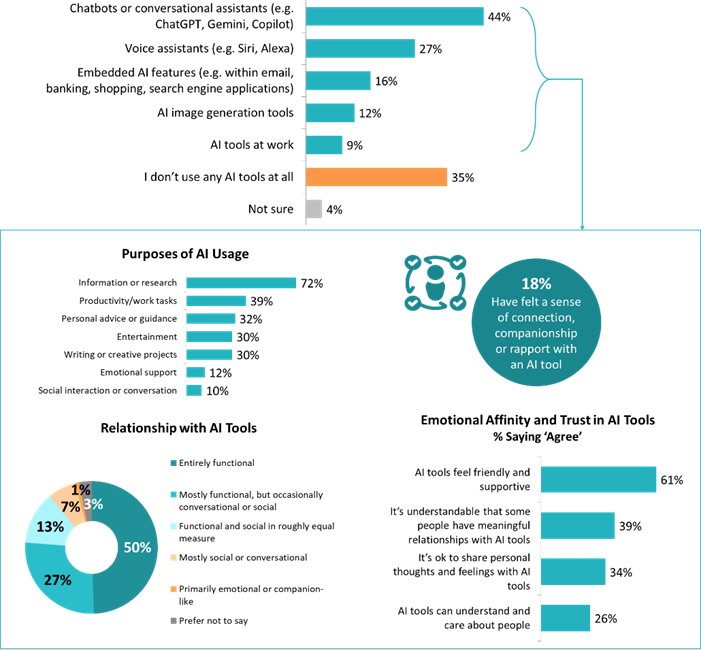
More than six in ten Canadians report using at least one AI-based tool or service, most often turning to chatbots or conversational assistants for informational purposes as well as work-related tasks. A third say they don’t use AI at all, underscoring that adoption is significant but not universal. Younger Canadians and higher-income households are notably more likely to be using AI tools.
Current Use of AI-Based Tools and Services
“Results show us that AI is being used widely across the population for information and research, along with assisting productivity,” said Margaret Chapman, COO & Partner at Narrative Research. “Interestingly, a significant minority are turning to AI for personal advice and guidance, and while AI seems friendly, most do not feel it has emotional understanding, yet.”
When asked to describe their relationship with AI tools, Canadians overwhelmingly feel they are functional, rather than conversational, social or companion-like. Only under 10% of AI users describe their interactions with AI as more human-like, being primarily emotional or mostly social or conversational. That said, four in ten admit to their interactions being social, at least occasionally. When asked directly if they have ever felt a sense of connection, companionship or rapport when using an AI tool, two in ten say yes.
Despite seeing AI as a generally functional tool to help with access to information and research, the majority agree that AI tools can feel friendly and supportive. Interestingly, although most don’t have human-like relationships with AI themselves, four in ten agree that it’s understandable for others to end up having meaningful relationships with AI tools. A third feel that it’s ok to share their personal thoughts and feelings with AI tools, and a quarter agree that AI tools can understand and care about people. Across results, younger Canadians are more likely to agree that AI can be more human-like.
Results are from an online survey conducted in partnership between Narrative Research and the Logit Group. The survey was conducted between March 12 – 16, 2026 with 1,230 Canadians, 18 years of age or older from the Logit Group’s online Canadian Omnibus. Data were weighted based on the 2021 Census, by gender, age, and region to reflect actual population distribution.
The questions asked were:
- Which of the following AI based tools or services do you currently use?
- For what purposes do you use AI?
- How would you describe your relationship with the AI tools you use?
- Have you ever felt a sense of connection, companionship or rapport with an AI tool?
- To what extent do you agree or disagree with the following statements:
- AI tools feel friendly and supportive
- It’s ok to share personal thoughts and feelings with AI tools
- It’s understandable that some people have meaningful relationships with AI tools
- AI tools can understand and care about people
Download a PDF version with data tables
FAQs
More than six in ten Canadians report using at least one AI-based tool or service, though about one third say they do not use AI at all
Most Canadians do not form emotional connections with AI, with fewer than 10 percent describing their interactions as human-like, though some report occasional social engagement
Younger Canadians and those in higher-income households are significantly more likely to use AI tools and view them as more interactive or supportive
For more information, please contact:
Margaret Chapman, COO & Partner, Narrative Research – 902.493.3834, mchapman@narrativeresearch.ca or Sam Pisani, Managing Partner, Logit Group – 416.629.4116, sam.pisani@logitgroup.com.
Narrative Research is a non-partisan, 100% Canadian-owned research company, certified as a Women Business Enterprise (WBE). Narrative Research provides clients with state-of-the-art research and strategic consulting services.
The Logit Group is a leading North American data collection and market research execution company headquartered in Toronto, conducting large-scale projects for a variety of well-known research agencies and brands. Logit employs industry-best technologies.